Water Heater Repair and Installation in Mesa
A water heater works out of sight until the morning it does not. Sirrine Plumbing repairs, replaces and installs tank and tankless water heaters across Mesa, and flushes them to clear the sediment that shortens their lives. Most heater calls start with one of three complaints: no hot water, not enough hot water, or water where it should not be.
Repair, Replacement, New Installs and Flushing
- Repair: heating elements and thermostats on electric tanks; burners, igniters, thermocouples and gas control valves on gas tanks; dip tubes, drain valves and temperature and pressure relief valves on both.
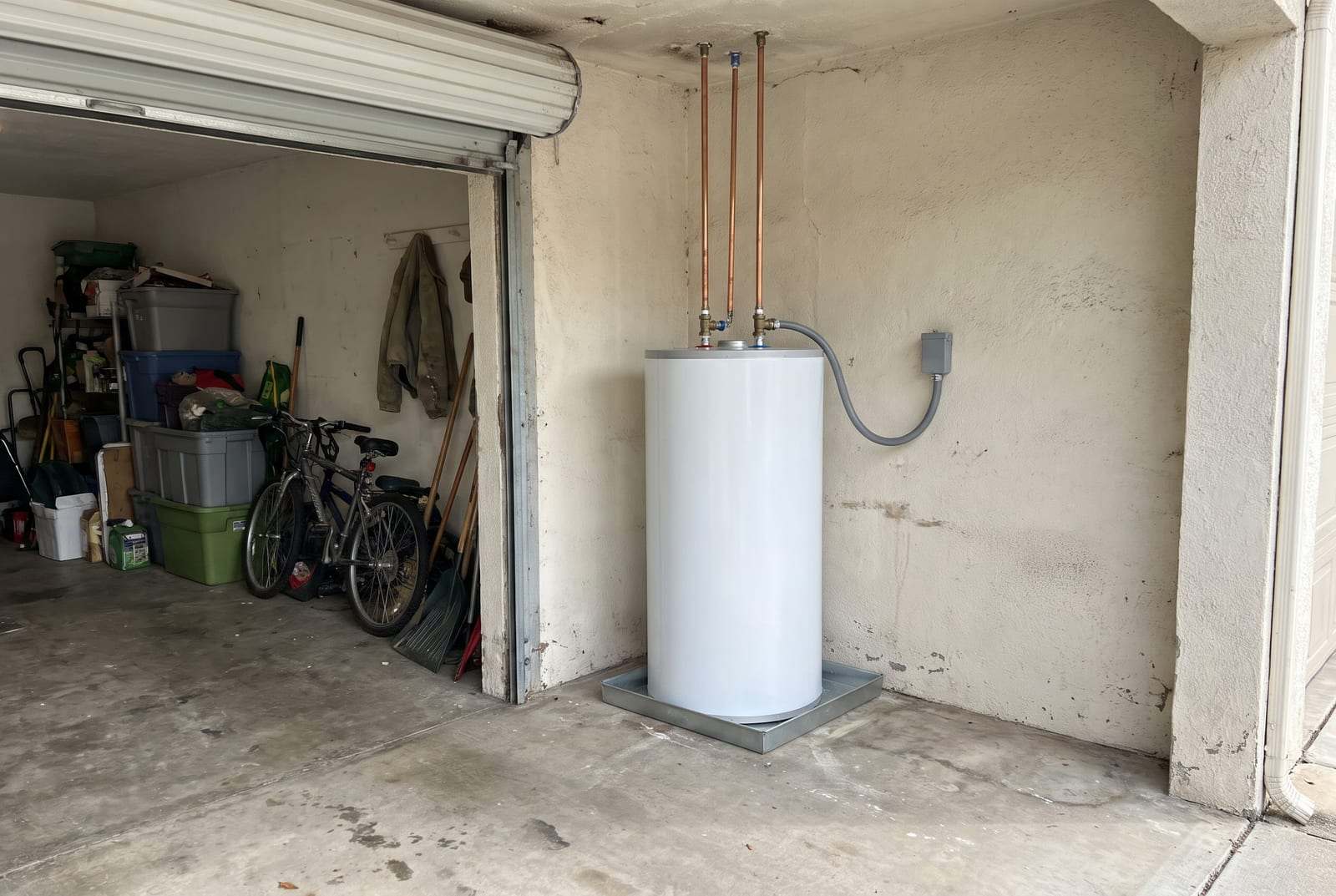
- Replacement: the old tank drained and disconnected, the new heater set in its pan, piped, filled and brought up to temperature.
- New installation: tank and tankless heaters, including a move from one to the other where the gas line, the venting and the electrical service allow it.
- Tank flushing: the loose sediment drained from the bottom of the tank before it hardens into a crust the burner or the elements have to work through.
Diagnosis starts with the basics: is the heater getting gas or power, is the relief valve dry, is the vent drawing, and how old is the tank. The age is printed on the label or coded into the serial number, and it decides a lot of what follows.
Warning Signs and What They Usually Mean
Heaters give notice before most failures. The sound, the color of the water and where water shows up say a lot about which part is going.
| Sign | Likely cause | Usually repair or replace |
|---|---|---|
| Rumbling or popping as it heats | Sediment on the tank bottom, with water trapped under it boiling | Flush it; an old tank that keeps rumbling is near its end |
| Hot water runs out early | A failed lower element, a broken dip tube, or sediment taking up space | Repair |
| No hot water at all | Pilot out, a worn thermocouple or igniter, a tripped high-limit switch, a burned-out element | Repair, once gas or power is confirmed |
| Relief valve pipe dripping | Pressure too high, expansion with no expansion tank, or a worn valve | Repair the valve, the pressure regulator or the expansion tank |
| Rusty or brown hot water | The anode rod used up and the tank starting to corrode | A new anode if caught early; a new heater once the tank rusts |
| Rotten-egg smell from hot taps | Bacteria reacting with a magnesium anode rod | Flush and change the anode |
| Water pooling under the tank | A leaking drain valve or fitting, or a tank rusted through | Fix a fitting; replace a leaking tank |
| Tankless flow dropping, error codes | Mineral scale lining the heat exchanger | Descale it; repair a sensor if the code returns |
Water pooling under the tank is the one sign that should not wait. Close the cold-water valve on the pipe above the heater, keep clear of the water, and follow the first steps under Burst Pipes.
When a Tank Is Worth Repairing
Most tank heaters last roughly eight to twelve years, and hard water like Mesa’s pulls that toward the short end. Scale coats electric elements until they burn out, and it builds a crust on the bottom of a gas tank that the burner has to heat through. The anode rod, the sacrificial metal rod that corrodes so the steel tank does not, gets used up faster too.
A heater under about eight years old with a failed element, thermostat, thermocouple or valve is usually worth repairing: the parts are common and the tank has life left in it. Past ten years, with rust in the water or a leak from the tank body, replacement makes more sense, because no part fixes a tank that has rusted through. In between, the deciding questions are how the tank sounds, what the anode looks like and whether the heater still fits the household.
Replacement is also the moment to rethink the type. A gas tank, an electric tank, a tankless unit and a heat pump heater each ask different things of the house, and the Heater Options comparison sets them side by side.
Water Heater Sizing Guide
Pick the household and its habits to see a tank size in gallons and the flow a tankless unit would need to keep up. It is a rule of thumb, not a load calculation.
Choose the number of people and bathrooms, tick any heavy-use habits, and press “Show the Suggested Size.”
A size range is a starting point. Bring it, along with the details from the old heater’s label, when you request an estimate, and the talk about type and size gets short.
Repairing, Flushing and Hard Water
Is it worth repairing a water heater that is ten years old?
Sometimes. If the tank is dry and the hot water runs clear, a common part such as a thermocouple or an element can buy it more time. If the water is rusty, the tank rumbles even after a flush, or water is coming from the tank body, the money is better spent on a new heater.
How often should a tank water heater be flushed?
Once a year is the usual advice, and hard water makes it worth keeping to. A flush drains the loose sediment before it hardens. On a tank that has gone years without one, the drain valve can clog with scale and a flush may stir up more than it clears, so an old, never-flushed tank is worth a look before anyone opens the valve.
Can flushing stop a tank from rumbling?
On a tank that is flushed regularly, yes: the rumble is water trapped under loose sediment flashing to steam, and draining the sediment quiets it. Where the sediment has hardened into a crust, a flush clears only the loose layer on top, and the noise usually comes back.
What does hard water do to a water heater?
The minerals drop out of the water as it heats. In a tank they settle on the bottom and coat the elements; in a tankless unit they line the heat exchanger and cut the flow. A water softener slows all of it (softeners are covered with the fixture work). Softened water does wear a tank’s anode rod faster, so the anode is worth checking more often.
Does a tankless water heater need flushing too?
Yes. A tankless unit has no tank for sediment to settle in, but scale builds inside its heat exchanger. Descaling means pumping a mild acid solution, often plain white vinegar or a descaler made for the job, through the unit by its service valves for about an hour. Where the water is hard, once a year is a common interval.