
Burst Pipe or Major Leak in Mesa: What to Do Now
Water spraying from a wall, pouring through a ceiling or spreading across the floor: close the main shutoff first, then call. Every minute the water stays on adds to what has to be dried out and replaced later.
Sirrine Plumbing repairs burst and leaking pipes in Mesa houses and small commercial buildings, from a split supply line under a sink to pinhole leaks in copper pipe and leaks under the slab.
While You Arrange Help
Work through these in order. Skip any step you cannot do safely.
- Find and close the main water shutoff. Turn a round handle clockwise until it stops; turn a lever a quarter turn so it sits across the pipe. If you cannot find the main, close the fixture stop on the line that broke.
- Turn off the water heater. On a gas heater, set the control knob to “Pilot” or “Off”; on an electric heater, switch off its breaker. A heater that keeps firing while its tank loses water can burn out an element or damage the tank.
- Open the lowest tap in the house. A tub spout or an outside hose bib drains the water left in the lines and takes the pressure off the break, so less comes out where the pipe failed.
- Switch off power near standing water, only if it is safe. Go to the breaker panel only if you can reach it without standing in water or touching anything wet. If you cannot, stay out of the wet area altogether.
- Move belongings out of the water. Lift furniture onto blocks, pull rugs and boxes off wet floors, and get electronics up and away from the water.
- Photograph the damage for your own records. Take pictures of the leak, the wet areas and anything damaged before cleanup starts.
Immediate Steps for Common Leaks
Not every leak needs the whole house shut down. Match what you see to the closest row.
| Situation | Immediate step | What to avoid |
|---|---|---|
| Pipe spraying inside a wall or ceiling | Close the main shutoff, then open the lowest tap | Standing under a ceiling that sags or bulges with water |
| Supply line burst under a sink or behind a toilet | Close the fixture stop on that line, clockwise until it stops | Forcing a stuck stop until it snaps; close the main instead |
| Water heater leaking from the tank | Close the cold valve on top of the heater and turn the heater off | Opening the relief valve or draining a tank that is still hot |
| Water near outlets, cords or the electrical panel | Shut off that circuit at the breaker, if the panel is dry to reach | Wading through standing water to get to the panel |
| Water bubbling up in the yard or the meter box | Close the customer-side valve in the meter box | Turning the valve on the street side of the meter, which belongs to the water provider |
| Warm spot on the floor, meter turning with every tap off | Close the main and request an estimate for slab leak detection | Pulling up flooring or breaking concrete to hunt for the leak |
Shutoff Finder: Where to Look First
Choose the kind of building. The result lists the places a shutoff usually sits, in the order worth checking, with a caution for that type of building.
Choose the type of home or building and press “Show Where to Look.”
Pinhole Leaks in Copper Pipe
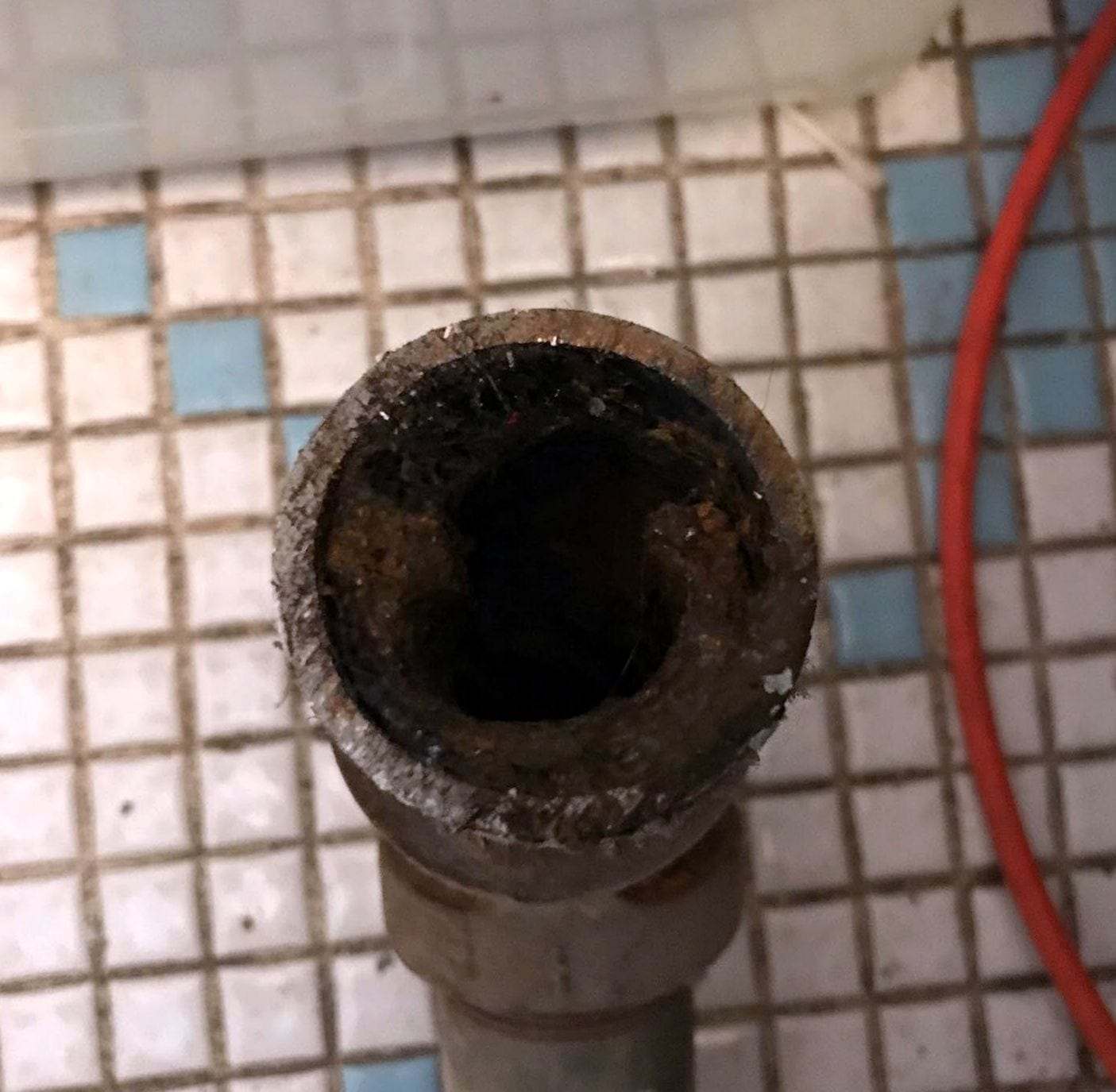
Copper supply pipe can fail from the inside out. Over the years, corrosion pits the wall of the pipe until a hole the size of a pin opens up. It starts as a fine spray or a slow drip inside a wall, and the first sign is often a stain on the drywall, a damp baseboard or a musty smell in a closet. Older galvanized steel pipe fails a different way: rust and mineral scale build up inside until the opening narrows and the pressure drops, and the wall rusts thin at the threads.
One pinhole is a repair: the damaged length is cut out and replaced, and every joint is tested with the water back on before the wall gets closed. Several pinholes in the same run, or a new one every few months, usually mean the rest of that pipe is thinning too, and replacing the run makes more sense than patching it again.
Signs of a Leak Under the Slab
Many Mesa houses sit on a slab-on-grade foundation, with the supply lines running under or through the concrete. A leak down there can run for weeks before it shows. Watch for these:
- A warm spot on a tile or wood floor, from a hot water line leaking underneath it.
- The water meter spinning, or its small leak indicator turning, with every tap and appliance off.
- The sound of running water when nothing is running.
- Damp carpet or flooring, or a crack in the slab that stays wet.
- A water bill that climbs with no change in how much you use.
Slab leak detection narrows down where the leak is before anything gets opened: listening for it through the floor, separating the hot and cold lines, and testing the pressure on each. Once it is found, the choice is between a spot repair through the slab and rerouting that line through the walls or the attic, which leaves the slab alone.
Slab Leaks, Frozen Pipes and Gas Smells
How can I check whether a leak is under the slab?
Turn off every tap, the irrigation and any appliance that uses water, then look at the meter. If the dial or the small leak indicator keeps turning, water is going somewhere. Now close the main shutoff at the house: if the meter stops, the leak is inside the house, often under the slab; if it keeps turning, the leak is on the line between the meter and the house.
Can a slab leak be fixed without breaking up the floor?
Often, yes. Instead of opening the concrete, the leaking line can be abandoned and replaced with a new run through the walls or the attic. Where the leak sits in a short, reachable spot, a repair through a small opening in the slab can make more sense. Which one fits depends on where the leak is, the age of the rest of the pipe and what flooring sits on top.
What should I do about a frozen pipe?
Hard freezes are rare in the valley, but a cold night can still freeze a hose bib, the backflow assembly on an irrigation line or a pipe in an outside wall. Open the faucet it feeds, then warm the pipe slowly with a hair dryer or warm towels, starting from the faucet end. Never use an open flame. Know where the shutoff is before you start: a split pipe often only begins to leak once the ice melts.
What should I do if I smell gas near the water heater?
Leave the building first, and take everyone with you. Do not switch lights, appliances or anything else on or off, do not light anything, and do not start a car in the garage. Once you are outside and well away from the building, call the gas utility from there. A water leak can wait until the gas is dealt with.
Is one pinhole leak a sign that more are coming?
It can be. A single pinhole may be a one-off from a flaw in the pipe or wear near a fitting, but pinholes in the same run of copper tend to come back, because the corrosion that made the first one is working along the rest of the pipe. Two or three in a year is a good reason to ask about replacing that run instead of patching each one.
Once the Water Is Off
When the main is closed and the area is safe, send the details: where the water came from, what kind of pipe it is if you can see it, and whether the leak is in a wall, a ceiling or the floor. The photos you took help too.