Water Heater Options for Mesa Homes
Five kinds of water heater cover nearly every house: the gas tank, the electric tank, gas tankless, electric tankless, and the heat pump, or hybrid, tank. None of them is the right answer everywhere. The choice turns on the fuel already at the house, the space the heater has to live in, how the household uses hot water, and how much flushing and descaling will actually get done.
Five Types Side by Side
More columns to the right: swipe.
| Type | Fuel or power source | Space and installation needs | Hot water delivery | Hard-water considerations | Best suited for |
|---|---|---|---|---|---|
| Gas tank | Natural gas or propane | A closet, garage or utility room with combustion air, a flue or power vent, and a gas line sized for it | A full tank stored hot; recovers quickly once drawn down | Sediment settles on the heated tank bottom and rumbles; flush once a year and check the anode | Homes with gas already piped and steady, predictable use |
| Electric tank | Electricity, usually a 240-volt circuit of its own | No venting; fits a closet or garage with room to reach the element covers | A full tank stored hot; recovers more slowly than gas | Scale builds on the elements and burns out the lower one first; elements can be replaced | Homes without gas, and smaller households |
| Gas tankless | Natural gas or propane | Compact and wall-mounted, but often a larger gas line, its own vent, and a condensate drain on condensing models | Hot water without running out, up to its flow rating; a short wait for heat at the tap | Scale lines the heat exchanger, cuts the flow and sets off error codes; descale once a year or more | Larger households, back-to-back showers and tight spaces |
| Electric tankless | Electricity, at a high amperage that may call for a bigger electrical service | The smallest units and no venting, but heavy wiring and breakers | Limited flow at once; whole-house models draw a great deal of power | Scale coats the elements; descale it and keep the inlet screen clean | A single sink, a far bathroom or a small home |
| Heat pump (hybrid) | Electricity, pulling heat from the surrounding air, with elements as backup | A tall tank with open air around it, a condensate drain, and a space that stays warm; it cools the room it sits in | A full tank stored hot; slower recovery on heat pump mode alone | The same tank scale as an electric heater, plus an air filter to keep clean | Electric homes with a roomy garage |
Two notes on the table. A tankless unit’s flow rating depends on how many degrees it has to add, so the same unit delivers more in a warm climate than in a cold one. And a heat pump heater works best in warm air: a Mesa garage that bakes all summer suits one well, and the cool air it gives off is no hardship there.
Mineral Scale Hits Each Type Differently
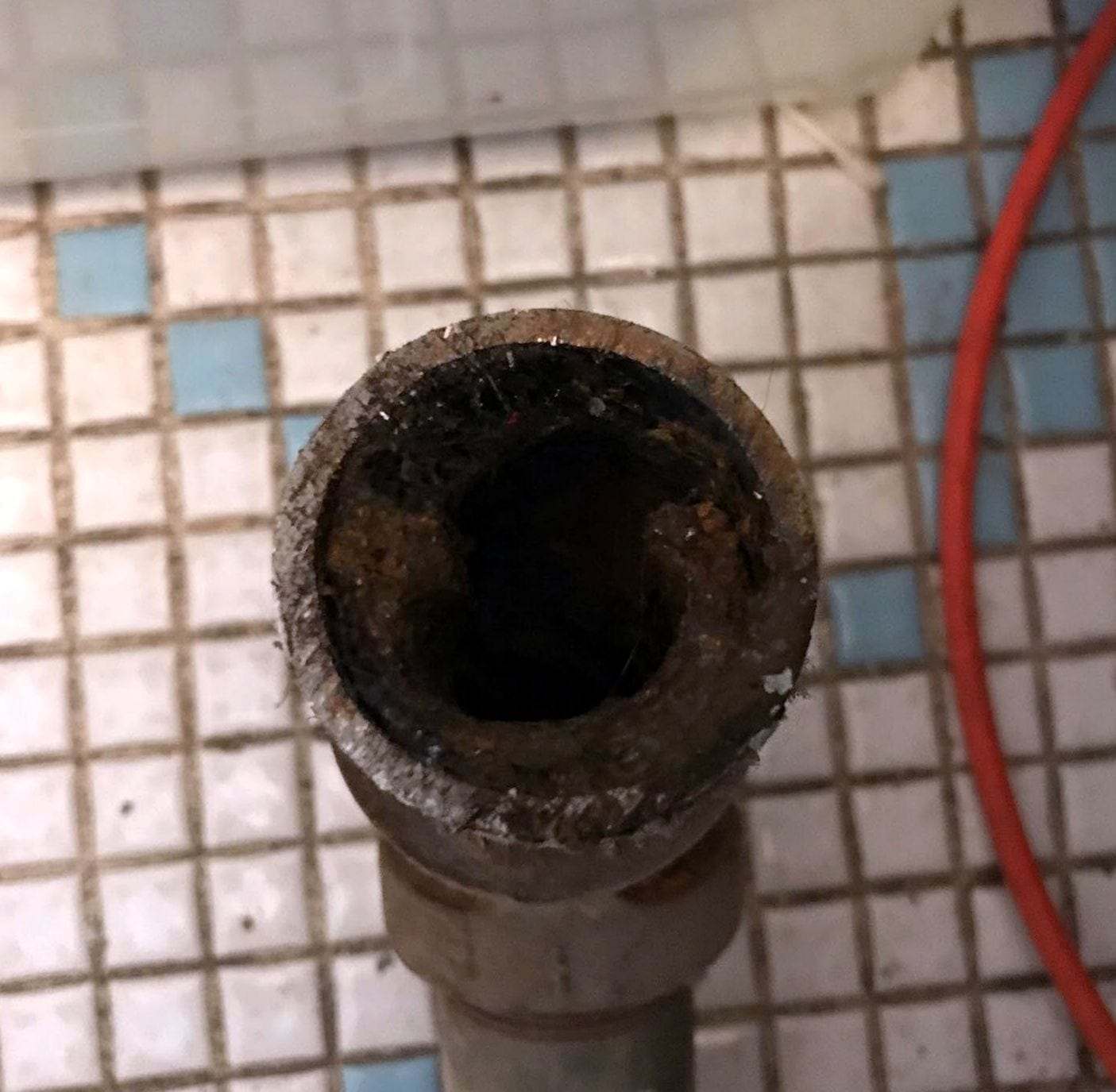
Mesa water is hard, and every kind of heater pays for it somewhere. Heating water drives the minerals out of it, and they collect wherever the heat is. Left long enough, scale narrows pipes the way it has in the one pictured, rust and mineral closing in from the walls until little water gets through.
In a tank, scale and sediment settle on the bottom. A gas burner has to heat through that layer, which wastes fuel and overheats the steel; an electric tank’s lower element gets buried in it and burns out. In a tankless unit, scale lines the narrow passages of the heat exchanger, so the flow drops and the unit starts showing error codes. A tank hides its scale until it fails. A tankless unit complains early, which makes the problem easier to catch.
Either way, the answer is upkeep: a yearly flush for a tank, a yearly descale for a tankless unit, more often where the water is very hard, and a water softener to take most of the minerals out before they reach the heater.
Tank or Tankless Where the Water Is Hard
Does hard water rule out a tankless water heater?
No, but it makes descaling part of owning one. Scale builds in the heat exchanger whatever the brand, and a unit that is never descaled loses flow and fails early. Isolation valves on the water lines, fitted when the heater goes in, make the yearly descale a short job.
Which lasts longer in hard water, a tank or a tankless unit?
A tankless unit that is descaled on schedule usually outlasts a tank, because there is no steel tank to rust through and most of its parts can be replaced. A tank eventually corrodes once its anode is spent, flushed or not. A tankless unit that is ignored, though, can fail sooner than a tank.
Does a water softener help both types?
Yes. Softened water leaves far less scale in a tank or a heat exchanger. In a tank, softened water also wears the anode rod faster, so the anode is worth checking every couple of years.
Is a tankless heater worth it for a small household?
Often not for the hot water alone: one or two people rarely run a 40-gallon tank out. The case for tankless is the space it saves, long or back-to-back showers that never go cold, and a longer life with upkeep. Against it are a new gas line or vent where one is needed, and the yearly descale.
Can a tank be swapped for a tankless unit in the same spot?
Sometimes, but rarely as a straight swap. A gas tankless unit usually needs a larger gas line and a different vent, a condensing unit needs a drain for its condensate, and an electric tankless unit may need a bigger electrical service. Those changes, more than the heater itself, decide how much work the switch takes.
Do heat pump water heaters handle hard water?
As well as an electric tank does, since the tank side is the same: flush the sediment once a year and keep an eye on the anode. The air filter on top needs cleaning too, more often in a dusty garage.
How to Choose Between Them
Work through these before deciding, and have the answers ready when you ask about a new heater.
- Household size and habits: how many people shower, how many at once, and whether anyone fills a large tub.
- Fuel available: whether gas is already piped to where the heater stands, and for an electric tankless unit, whether the electrical service can carry the extra load.
- Space: the closet, garage corner or wall where the heater will go, with room to service it and, for a heat pump, open air around it.
- Venting: where a gas unit’s flue or vent pipe can run to the outside, since a tankless or power-vent heater often needs a new route.
- Upkeep: whether a yearly flush or descale will really happen once the heater is in.
For the size side of the question, the sizing guide on the Water Heaters page gives a tank range in gallons and the flow a tankless unit would need for your household.
Once the list is down to one or two types, a look at the house settles the rest: the gas line, the vent route, the space and the electrical service. Request an estimate with the type you have in mind, or call to talk it through.